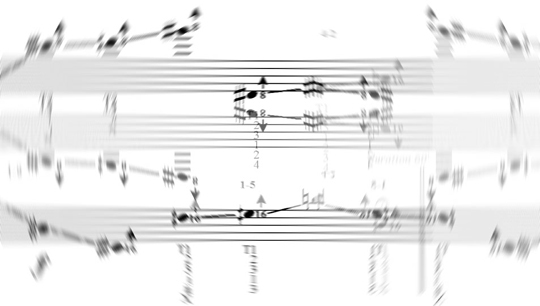
Atlas Eclipticalis is the title of the collection of astronomical charts employed by John Cage in the composition of his work of the same name. Using transparent overlays he determined by means of chance operations which stars on the charts were to be notes and how these notes were to relate to one another. The work, commissioned in 1961 by the Montreal Festivals Society, was completed in 1962 and comprises 86 instrumental parts (for full orchestra) “to be played in whole or part, any duration, in any ensemble, chamber or orchestral." The present recording superimposes digital tapings of three parts for flute “(treble clef) changing with piccolo and alto flute ad lib. “ without a conductor. A performance may be at any point between minimum activity (silence) and maximum activity (what’s written). Based from my correspondences with Cage in 1987, my recording, completed in January, 2002, represents the culmination of a project spanning over the last 15 years, in terms of analysis of the existing three parts for flute, the generation and notation of precise “micro-tonal” versions of each, and the resulting digital recording and editing of each part, plus “doublings” (9 parts total). This final recording is dedicated to the great shakuhachi master, Masayuki Koga. Since 1983, the sagacious virtuosity of Masayuki Koga has had the most profound influence on my personal artistry. His friendship and guidance have been invaluable, and without whom, this album would not have been possible. Only the natural sound of the instruments is heard. My rendition takes into consideration the cognitive processes involved when responding to graphic stimuli. With traditional “Cagean” performance practice as a point of departure, I sought to create what I term a practical or natural performance version, taking into active consideration the neurological formatting that occurs when any thing is encountered more than once...(i.e. memory). Idealistically, any performance of John Cage’s music can be made only once, and that by “sight-reading” a single part in concert. Thus, only three ideal performances of Atlas are possible by a single performer. By ideal, I mean renderings that are completely spontaneous without preconception. While this seems to represent an adherence to what many have come to believe as to be the essence of the Cage aesthetic (i.e. Taoism in particular), a broader view of these elements is in order. The creative freshness sought by Cage through the utilization of chance operations, find their roots in the Taoist classic, the I Ching (The Chinese Book of Changes). In Taoism, there is nothing chance in existence, rather change occurs through a very specific and complex series of seemingly separate, yet interdependent circumstances creating a unified outcome, with the physical world being a reflection of the non-physical world. A more fitting interpretation of Mr. Cage’s aesthetic is existential; a state of being based organically on how things ARE. All things being equal, organacy in this case is what actually occurs in the world of serious art music; sociologically, as well as the psycho-emotional drives, shapes and fields that are intrinsic to the process. Subsequently, my rendering of Atlas is a codification based upon my perception in relation to the graphics presented as means to an end, the performance. My re-notation, as it were, is nothing more than a clarifying mechanism for performance focus and posture, resulting in a less cluttered mental state. More time is spent in the actual performance of the piece, less in cognitive mid-breath and limbic choice.
C.V.
Copyright©cjvickers; 2005. All rights reserved.
